
Hermes roundup, July 3: six community builds on v0.18, from a Rust CDP plugin to /bioinformatics
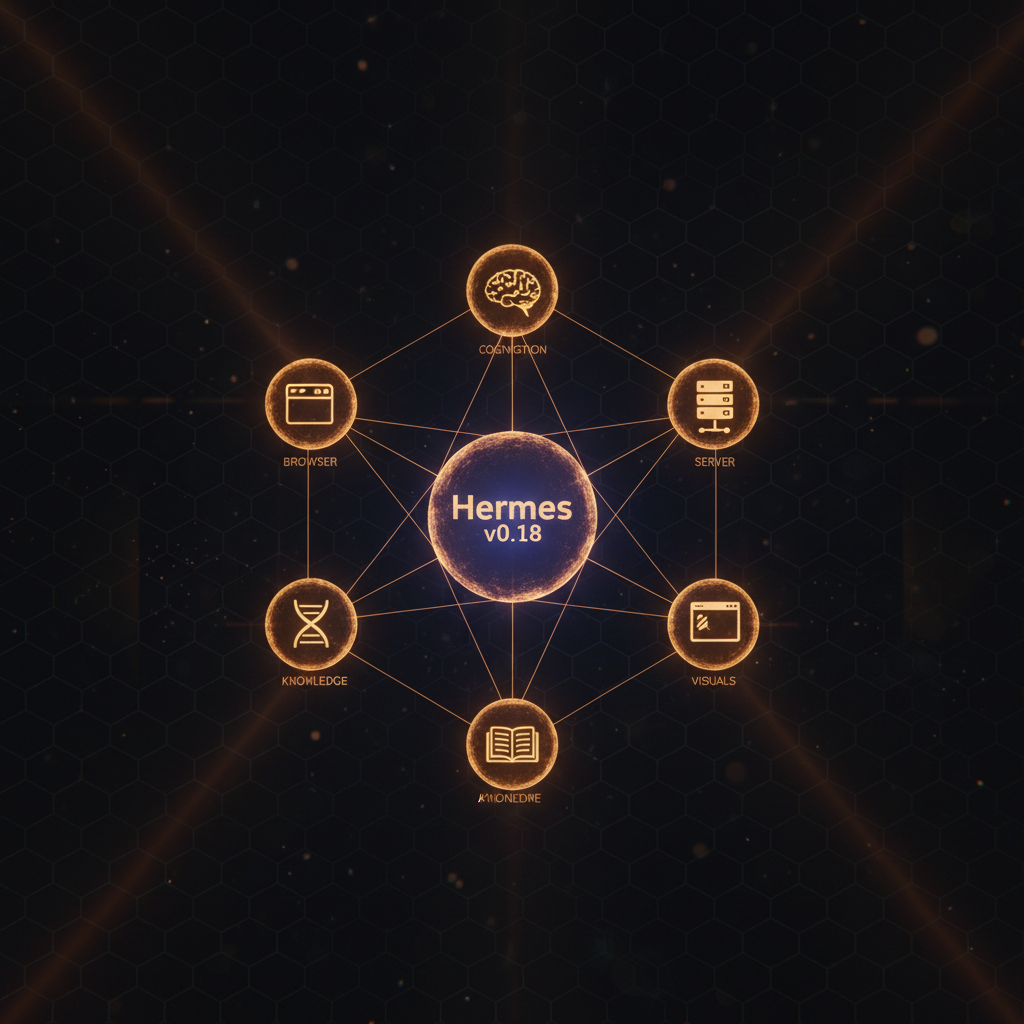
The 24-hour window was a community-implementation cycle. Teknium's v0.18 "Judgement Release" announcement on July 1 (1840 likes, 185 retweets, 562 bookmarks, 308,707 impressions) is the structural backdrop, but the fresh signal is what six independent builders shipped on top of it. None of the six are from Nous. All are from people who have the agent running and just shipped something.
A Rust engine for the browser tools
Obscura posted the freshest implementation in the window at 13:50 UTC on July 3. The plugin runs Hermes' browser tools on a lightweight Rust engine over CDP - no Chrome, no Node, ~30MB RAM per session. The numbers are small (2 likes, 1 retweet, 5 impressions in the first hour). The technical claim is not.
The headline is the 30MB figure. A standard Playwright/Puppeteer browser session on Hermes Desktop runs a full Chromium process. The Obscura plugin replaces that with a Rust binary that speaks CDP directly, no Chrome, no Node, no V8, no extension surface. The cc to @Teknium1 is a tell - this is being pitched as a v0.18 desktop integration candidate, not a standalone launch.
Memory compounding
CDGalpha published a memory how-to at 12:19 UTC on July 3: 16 likes, 0 retweets, 494 impressions, with a longer tutorial behind the link. The pitch: Hermes builds a knowledge base that gets smarter about you every time you use it. Every chat compounds instead of vanishing.
The framing is "every chat compounds" rather than "Hermes stores your data." That maps to the v0.18 surface area: persistent context, not persistent database. The 16 likes in the first 90 minutes are operator-signal.
MCP server flow on Desktop
mr_r0b0t posted an MCP testimonial at 12:55 UTC on July 3: 4 likes, 0 retweets, 253 impressions. "If you have ever gotten annoyed configuring your MCP servers, I'd recommend you give it a try using Hermes Desktop." The "just got even better" line is the v0.18 link - the MCP server flow in Hermes Desktop was one of the v0.18 polish areas.
/bioinformatics returns three lab pipelines
deepquest ran a /bioinformatics slash command at 13:03 UTC on July 3 and got three lab pipelines back. The numbers are small (1 like, 0 retweets, 15 impressions). The technical claim is the largest of the window: a single command produced an Exosome Pipeline (Isolation QC, Cargo Profiling, Functional Annotation), a sequencing pipeline, and a functional genomics pipeline. The tools named are real - MaxQuant, DIA-NN, proDA, Salmon.
The /bioinformatics slash command appears to be a custom operator-defined command, not a stock Hermes feature. The slash-command surface is part of v0.18's broader context-engineering direction. A domain-specific pipeline command that returns production-grade tools is the v0.18 payoff.
The setup guide for first-time users
Youssef Hosni published a setup guide at 13:22 UTC on July 3 - the guide he wishes had existed when he first set up Hermes Agent. 1 like, 32 impressions; the post is a long-form guide at the linked URL. The signal is meta: the v0.18 release pulled in enough new users that the install-to-working-setup gap is now a publishable how-to, not a Discord thread. The guide market is the leading indicator of adoption.
26 likes on a screenshot
Oz posted a screenshot at 11:32 UTC on July 3 - the highest-engagement non-Nous post in the 24h window at 26 likes, 5 retweets, 15 bookmarks, 1,414 impressions. The bookmark-to-like ratio of 0.58 puts it in the operator-signal tier. The tweet text is a single URL. The image is the entire post.
15 bookmarks on a link-only tweet is the signal: the audience saved the underlying image or article to come back to. The pattern is reference content, not announcement content. The image is behind the t.co short link and the oEmbed API returns the bare URL with no preview.
The v0.18 frame
Teknium's v0.18 announcement is the structural backdrop for every post in this roundup. The 1840-like release tweet on July 1 surfaced three v0.18 surface areas: Mixture of Agents as a virtual model, /learn to teach the agent from open-ended sources, and Journey to visualize what the agent did. Each of the six community posts above attaches to one of those surface areas. The Obscura plugin attaches to the browser tool surface. CDGalpha's memory how-to is the persistent-context angle. mr_r0b0t's MCP testimonial is the desktop-flow polish. deepquest's /bioinformatics is the slash-command surface. Youssef's setup guide is the v0.18-driven adoption wave. Oz's screenshot post is reference content pulled from the broader workflow.
Footnotes
[^1]: Teknium @Teknium. "Hermes Agent v0.18.0 is here. The Judgement Release." X. July 1, 2026.
[^2]: Obscura @obscura_sh. "You can now run @NousResearch Hermes agents with Obscura." X. July 3, 2026.
[^3]: CryptoDiggerGod.eth @CDGalpha. "this is how you can make your AI remember everything" X. July 3, 2026.
[^4]: mr-r0b0t @mr_r0b0t. "If you have ever gotten annoyed configuring your MCP servers..." X. July 3, 2026.
[^5]: deepquest @deepquest. "When you hit /bioinformatics in hermes @NousResearch" X. July 3, 2026.
[^6]: Youssef Hosni @YoussefHosni951. "I wrote the guide I wish existed when I first set up Hermes Agent." X. July 3, 2026.
[^7]: Ojasvika Sahu (Oz) @Ozacle23. "screenshot post" X. July 3, 2026.
[^8]: Hermes Agent v0.18.0 release notes. The structural changes for /goal completion contracts, persistent memory, and the Mixture-of-Agents virtual model are documented in the linked changelog.